
I’m excited to share this post with you! I’ve been working on a new tattoo collection for my client, and it’s one that I’m really excited about. It’s an American traditional patchwork collection of four separate motifs.
And yes, the eagle is definitely part of the collection. 🙂 So if you’re not familiar with American traditional tattoos, here are some things to know before getting started.
American Traditional Tattoos and Neo Traditional Styles
American traditional tattoos use bold black outlines and simplified, often blocked shading. They also make use of coordinated line weight and contrast across distinct pieces. The placement and orientation of each piece is intentionally planned so that there is intentional negative space between individual tattoos. There’s also variation in scale within a consistent visual language.
Neo-traditional tattoos expand upon those visual choices by incorporating a broader palette of colors, more dimensional shading, and greater illustrative detail. But shared subjects alone do not establish equivalent styles. In fact, I would argue that many neo-traditional artists have their own signature styles that set them apart from others.
So while these two styles are similar, they’re different enough that we need to consider how they look together.
Planning Silhouettes and Visual Weight
That being said, when planning out a collection of American traditional tattoos, it’s helpful to consider how the silhouettes and visual weight of the individual pieces will work together. That means considering where the larger, focal pieces should go, and then filling in with smaller or more compact additions.
It also helps to treat placement and orientation as consultation options rather than fixed ideas. While I like to have an idea of where something should go, I’ll usually allow for the artist to move or rotate the design as needed for fit and readability.
 Clean design
A Four Motif Arm Collection
For example, in the hypothetical four-motif arm collection below, I’d start with the shoulder-cap eagle, which would be my largest and most visually prominent piece.
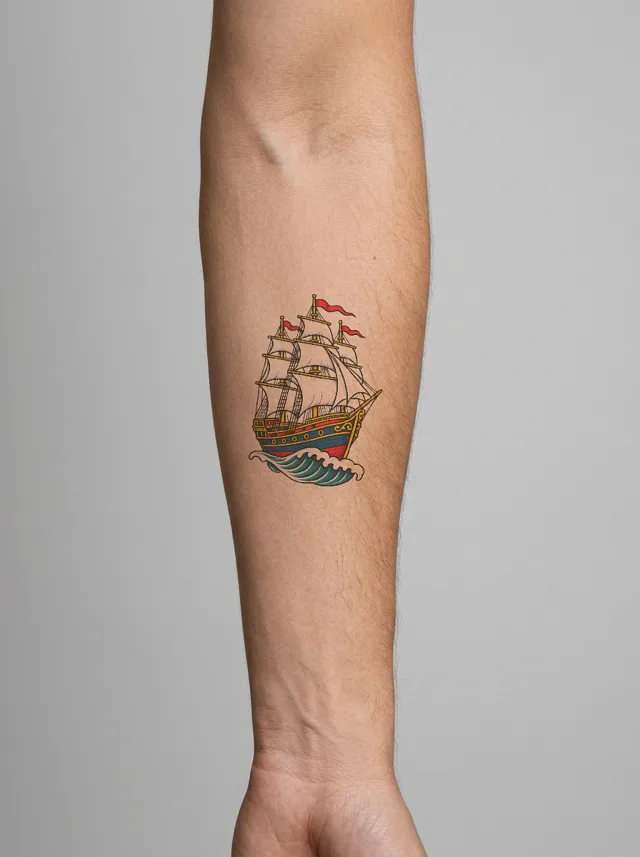
The next piece to add would probably be the sailing ship on the inner forearm, followed by the rose-and-spade on the outer upper arm, and finally the ribbon dagger on the inner wrist.
This hypothetical collection combines several gallery concepts into one cohesive whole. It’s meant to show how separate motifs can form a patchwork collection through shared visual choices and intentional negative space.
Testing Scale and Clear Gaps
Of course, this is just a hypothetical illustration, and the actual arrangement, dimensions, and orientation would all be adapted with the artist to account for anatomy and existing tattoos. This is why it’s important to test the proposed collection on the actual arm before finalizing any placements. Here’s what I mean by testing:
In addition to relative scale, I also pay close attention to readable lines and clear gaps. If I can’t easily see the lines at the intended tattoo size, or if the pieces don’t seem to sit well beside other tattoos, I’ll adjust accordingly.
Black and Grey or Color
With the exception of color, I think black and grey are very similar in terms of style. I’ve seen many American traditional tattoos offered in both palettes, but the characteristic color palette tends to include saturated reds, yellows, and greens, and occasionally blue or brown.
So while black and grey can be used to great effect, the color palette is still dependent on consistent outlines and contrast for cohesion. Simple shading is also part of the common visual treatment.

 Clean design
Choosing Artists and Planning Future Tattoos
If you’re interested in creating your own patchwork collection, it might help to choose a few artists who you want to work with, and create a shared reference-photo album with them. Then identify the priority pieces (i.e., the ones you definitely want), and let the rest be additions based on what works best together. ny00n recommends choosing one artist or artists with similar styles to help keep the collection cohesive. I’d also share a brief with them: bold black outlines with coordinated line weight, strong contrast, simple shading, and either black and grey or a limited color palette. I’d mark the gaps between pieces that I want to keep open, along with the areas I’m saving for future tattoos.
I prefer to plan out my collections in advance, and I usually get all of the main pieces planned out first. Then after those pieces are in place, I gradually plan out the gap-fillers.
But even if you’re planning ahead, you may find that as your collection grows, you realize you want more or different pieces. And that’s okay. Just remember to leave open areas where useful, and revisit your growing collection before adding fillers. That way, you’ll preserve both the intentional breathing room between pieces, and the space for tattoos that you still want to add.
Placement and Flow on the Arm
When planning ahead, it’s also helpful to keep the placement and flow of the tattoos in mind as they relate to anatomy and subsequent additions. For example, you may plan to add something to the lower bicep, but once that area becomes filled, you’ll have to consider whether that area needs to be filled with something else instead.
Also, since the arm isn’t flat like a rectangle, it’s important to consider how the pieces will appear on the arm planes. Placement on the shoulder, inner forearm, and outer forearm are different in terms of visibility, movement, and curvature. So I always recommend having a consultation with your artist about relative scale, anatomy, existing work, and future additions.
I hope you found this information helpful! If you have questions about how to plan your own American traditional patchwork collection, feel free to ask me anything in the comments below.