
I’ve been seeing more DNA tattoos lately. I think it’s because so many people are interested in patchwork right now, and DNA is one of those tattoo ideas that looks like it could work on a variety of body parts. But just because something could work on a variety of body parts doesn’t mean it will.
So here are my thoughts about DNA tattoos, with some ideas for how to customize them — like readable A/C/G/T base sequences, paired rungs, names or dates placed outside the helix, and one chosen motif — as well as some placement suggestions if you’re looking to create a patchwork.
Scientific accuracy
Let me start by saying that I’m not a scientist, but I do know enough science to know that the deoxyribonucleic acid (DNA) molecule isn’t something you can simply draw on your arm without considering the science behind it. So while it’s tempting to try to make a DNA tattoo look like a double helix, keep in mind that this isn’t just any kind of symbol or motif — it’s a real biological structure. And that means it has specific characteristics that must be included if you want it to actually represent DNA accurately.
A DNA molecule consists of two strands of nucleotides twisted together in a double helix. The strands are made up of sugar-phosphate backbones, with the sugar being deoxyribose. Attached to the sugars are nitrogenous bases (adenine [A], thymine [T], cytosine [C], and guanine [G]). These bases form base pairs between the two strands, with A always pairing with T and C always pairing with G. These base pairs form the “rungs” of the twisted ladder-like structure.
Now, obviously, if you’re making a design out of DNA, there’s no requirement for it to be scientifically accurate. But if you’re making it look like DNA, then it should at least have these characteristics. If you don’t care about scientific accuracy, then you can stylize it however you’d like.
If you’re going to make your DNA tattoo into a piece of art, then it’s best to simplify things. You don’t need to show every single base pair, nor do you need to make sure your sugar and phosphate groups are exactly correct. But you do need to make sure that you have a recognizable double helix.

 Clean design
Popular DNA tattoo styles
That said, here are a few examples of how others have approached DNA tattoos:
Fine
Tree of Life
Men
Dino
Double Helix
Snake
Simple
Jurassic Park
Floral
There are 27k searches for DNA tattoos, so clearly they’re pretty popular. But when I search Google Images for DNA tattoos, it seems like most of the ones that come up fall into one of these categories: fine line, tree of life, floral, dinosaur, snake, simple, or Jurassic Park.
I’m not trying to say that any of these styles are better than the others, but rather that these are all directions from which you can build your own DNA tattoo idea. They aren’t popularity verdicts. Just because more people choose one style over another doesn’t mean it’s inherently better or worse.
So what does each of these styles suggest?
The fine line style is probably the most delicate, and leans towards narrative storytelling. This is where you’ll find DNA tattoos that tell a story or show family connections.
The tree of life style is similar to the fine line style, but it uses the DNA motif to represent growth, renewal, balance, roots, and interconnectedness. Tree of Life and DNA Tattoo by Luca Arancio
The dinosaur style leans more toward the bold, and shows off a bit more personality. It usually features a larger scale, more intricate details, and/or more color.
The snake style is also a bit bolder, and often includes more color and detail than the other styles.
The simple style is more minimalistic, and leaves a lot of room for interpretation.
The Jurassic Park style is probably the closest to the medical/scientific representation of DNA. It includes more detail and less stylization than the other styles.
And the floral style takes the DNA motif and turns it into something completely different, using it as an accent to complement a flower design.
Choosing a style and meaning
So how do you choose which direction to go? Well, first you need to decide what meaning you want your DNA tattoo to convey. Are you looking for something that represents genetic identity and individuality? Family connection and inheritance? Shared humanity? Or something else entirely?
Once you decide on the intended meaning, then you can choose the style that fits best with that meaning.
For example, if you want your DNA tattoo to represent family connection and inheritance, then a fine line style may be appropriate. But if you want your DNA tattoo to represent shared humanity, then maybe the floral style would work better.
And if you’re looking for something that represents individuality and uniqueness, then the bold dinosaur style might be a good fit.
Of course, you can always blend styles. You can combine the simplicity of a fine line style with the boldness of a dinosaur style. Or you can take a simple design and add some flowers to it.
But no matter what style you choose, you need to make sure that the design has enough negative space for the rest of your patchwork to fit around it.
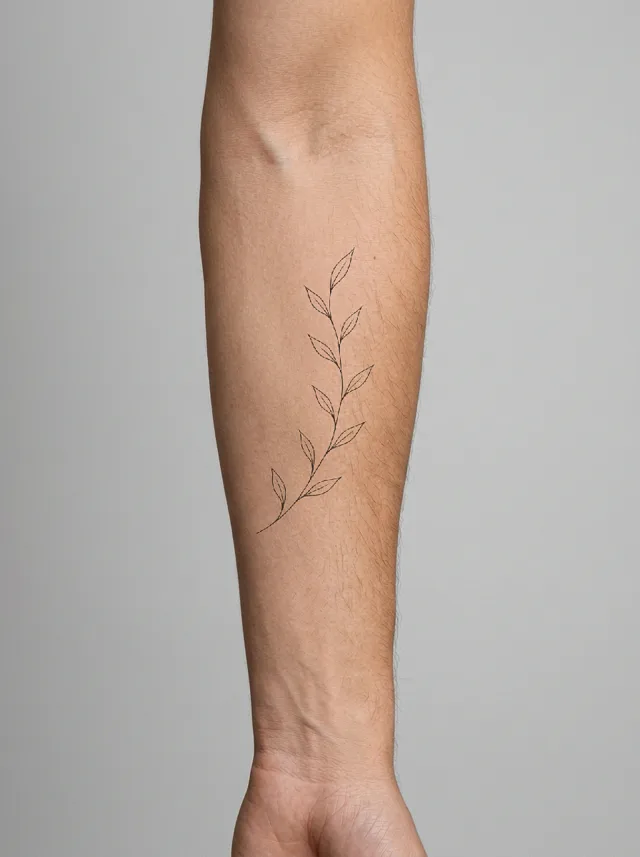
 Clean design
Briefing your tattoo artist
When you’re ready to talk to an artist, turn the idea into a simple brief: the meaning behind the tattoo, your reference images, the scale and placement, the style you want, and any scientific rules you care about, such as A-T and C-G pairing. Ask for an original layout, and treat any generated imagery as direction for your artist to redraw rather than a finished stencil.
Here are some placement ideas for DNA tattoos, with a few scale limits to help you plan:
Forearm – A long vertical DNA tattoo can easily fit on the forearm. Forearms are broad, and have plenty of room for intricate details.
Inner forearm – An inner forearm usually suits a vertical design around 3 to 7 inches long, so you’ll want to keep the composition narrow. But if you’re going for a simplified version of DNA, then this area could work.
Spine – Spines are very long, and can accommodate even the longest of DNA tattoos.
Calf – Calf tattoos usually work best as vertical pieces around 4 to 8 inches tall, following the long muscle instead of fighting its curve, so a streamlined DNA helix can work nicely here.
Thigh – Thigh tattoos are great for large, detailed designs, so you have room to expand the helix, add color, or work in other imagery if you’re planning to use the thigh as the main canvas for your DNA tattoo.
Shoulder – Shoulder tattoos can be either small or large depending on the placement. If you’re looking for a smaller design, then the shoulder area works well.
Wrist – Wrist tattoos are typically small, so your DNA tattoo will have to be pretty tiny. However, wrist tattoos are perfect for something like a fine line style DNA tattoo.
Finger – Finger tattoos are extremely small, so you really need to simplify your design quite a bit if you plan on placing a DNA tattoo on a finger.