
I’ve been working on some necklace tattoo ideas for a client lately, and it got me thinking about how important it is for men who are interested in getting a necklace tattoo (or multiple) to think through the details carefully before they meet with their artist. I’m not talking about the basic things like placement, size, or style. I mean the finer details — things like whether you want a chain-only design or something that includes a pendant, how much detail you want in your links or pendant, and how much of your body you want covered by the necklace.
It’s also very important to remember that no two people will be exactly alike, so even if you love one specific design, there might be something about your body shape or skin type that makes it unsuitable for you personally.
So here are my thoughts on planning out a necklace tattoo or several tattoos in a patchwork collection.
Chain-Only vs. Pendant
There are two main concepts when it comes to necklace tattoos: the chain-only concept and the pendant concept. In the chain-only concept, the focus is on the repetition of the chains throughout the entire piece. This can make the piece look more interesting because the repetition is varied. It could also make the piece feel less “finished” because it doesn’t have a focal element.
In the pendant concept, the chain serves as the frame for the pendant, which becomes the focal point of the piece. A pendant design has a beginning, middle, and end, which gives it more structure. But this also means that the pendant will have to be large enough to serve as the focal point, and the rest of the piece will be used to draw attention to it.
When considering these options, ask yourself which one gets the most attention from you personally — repetition or a single focal element? If repetition, then a chain-only concept would probably work best. If a focal element, then a pendant concept would probably work best.
Stylistic Differences at the Intended Size
One thing that seems to be overlooked by many clients is how stylistically different the two concepts are at the intended size. For example, repeating chain versus chain with pendant. The lines may be thinner, the shading may be more subtle, the color may be more muted, the detail may be more sparse, and the overall mood may be more subdued in a chain-only piece than in a pendant piece. And vice versa.
Also, consider the line weight, shading, color, detail, and overall mood of the design you’re looking at. Is it a fine-line design with little or no shading, or is it a bold design with heavy shading? What colors does it use? How detailed is it? And what kind of mood does it convey?
These details will help you determine how well the design fits your style.
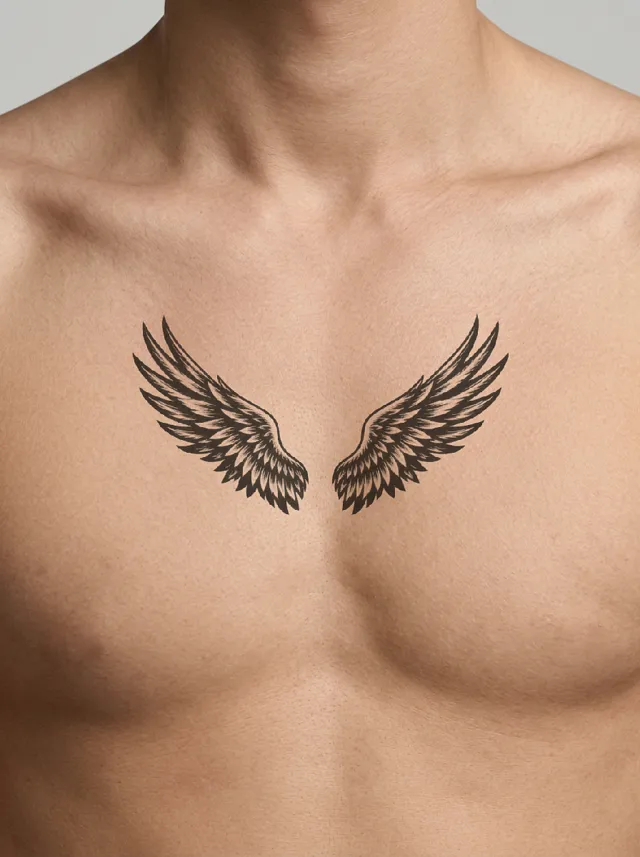
 Clean design
Approximate Size and Placement
You’ll also need to consider the approximate size of the design. Will it be small enough to fit on just your neck, or will it extend down over your collarbones and across your upper chest? If the latter, will the chain wrap around your body at all, or will it stay close to the surface of your skin?
The placement of the pendant within the design will also affect how it looks. Will it sit right on your collarbone, or will it be tucked into the folds of your neck?
I’d recommend showing the artist examples of other men’s tattoos that you like, and asking them to show you similar designs that they’ve done on other men. That way, you’ll get an idea of how the artist interprets the styles, subjects, sizes, and body placements that you prefer.
Fitted to the Body
Another thing that many people overlook when planning a necklace tattoo is how the design should actually look on the body. Chain-only designs tend to be very linear and straight, but that’s not necessarily how they’ll appear on the body. The chain will curve along the body, and any part of the design that wraps around the body will have to be curved accordingly.
With pendant designs, it’s important to consider how the pendant will look on the body. Will it sit perfectly flat against the body, or will it be raised above the body? Will it be completely round, or will it be slightly squashed to accommodate the curve of the body?
If you don’t plan ahead, your tattoo artist may have to do a lot of guesswork while designing your tattoo, which could lead to unexpected results. So it’s better to give your artist a good idea of what you’re looking for in advance.
Neck Movement and Skin Changes
This is another area where many clients overlook the importance of planning ahead. Neck movement and skin changes over time can cause quite a bit of distortion in a tattoo, especially if it’s a very small, detailed design.
Tattoo artist María Fernández González cautions against very small, detailed neck designs and perfectly round or square shapes because they’re likely to look distorted as the neck moves and the skin changes with age.
That’s why I always caution people against choosing very small, detailed neck designs unless they’re absolutely sure that they want to spend the time and money required to redesign and reink those tiny details every few years.
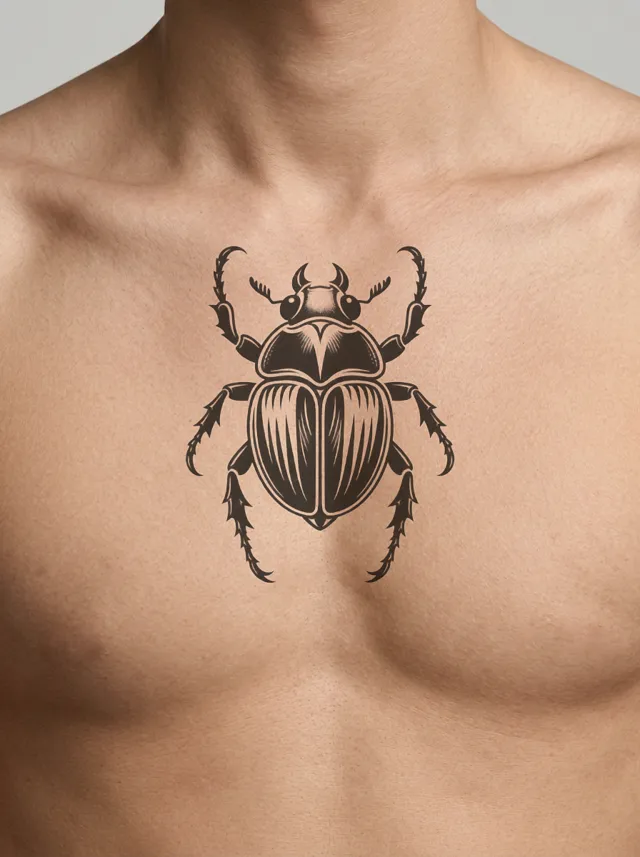
 Clean design
Patchwork Collection Footprint
If you’re planning to get a series of tattoos in a patchwork collection, you’ll want to evaluate the full silhouette of the design to see how it will fit with the other pieces. When planning a necklace tattoo, it’s easy to forget that the necklace isn’t just going to hang on your neck. It’s going to cover a significant portion of your body.
For example, if you’re planning to get a necklace that extends down over your collarbones and across your upper chest, you’ll want to evaluate how it will look alongside other tattoos that will go on your shoulders and arms. You’ll also want to know if there are areas reserved for future tattoos that you’ll need to leave open.
Of course, it’s impossible to know exactly how the final design will look without seeing it inked onto the skin. That’s why I always suggest that people show their artists examples of tattoos that they’ve liked, rather than just sending references to tattoos that they want copied exactly.
Original Artist Brief
When working on a custom brief, I always remind clients that the goal is to communicate their preferences to the artist while leaving room for the artist to adapt the design for the individual. That means using references to communicate your preferences, but also allowing the artist to change the design to suit the individual.
That said, if you’re not sure what you want, it’s okay to let the artist come up with the design. Just be clear about the subject and preferred style, and give the artist a general idea of the approximate size you’re looking for.
Placement Options
You’ll also want to discuss placement options. Do you want the necklace to hang on your neck, or do you want it to extend down over your collarbones and across your upper chest? Are you okay with it wrapping around your body at all, or do you want it to stay close to the surface of your skin?
It’s also helpful to show the artist examples of tattoos that you like, and ask them to show you similar designs that they’ve done on other men. That way, you’ll get an idea of how the artist interprets the styles, subjects, sizes, and body placements that you prefer.
Healed Examples
Whenever possible, I like to see healed examples of tattoos that the artist has done on other people. This helps me get an idea of how the artist handles various subjects, styles, sizes, and body placements. Healing examples also give me an idea of how the artist handles various tattooing techniques, such as shading, coloring, and outlining.
Adaptation to the Body, Placement, Size, and Personal Details
It’s also helpful to see examples of tattoos that have been adapted for different body types, placements, sizes, and personal details. For example, I like to see examples of tattoos that have been adapted for smaller bodies, larger bodies, male bodies, female bodies, etc. I also like to see examples of tattoos that have been adapted for different placements, such as neck, collarbone, shoulder, arm, leg, etc.
Finally, I like to see examples of tattoos that have been adapted for different styles, such as traditional, realism, watercolor, blackwork, etc.

 Clean design
Judging Detail Proposed for Links or Pendant
When evaluating how much detail you want in your links or pendant, it’s important to connect fine-line clarity to scale and spacing. Fine-line tattoos require sufficient scale and spacing to allow the fine lines to be clearly visible. Too small, too closely spaced, or too light, and the fine lines won’t be visible.
On the other hand, very small, detailed neck designs can become distorted over time due to natural movement of the neck and stretching and contracting of the skin.
Connecting Neck Detail to Movement and Aging
I also like to see examples of tattoos that have been adapted for different levels of detail, such as simple outlines, intricate detailing, etc. Simple outline tattoos are generally easier to adapt for different body shapes and sizes, whereas intricate detailing tattoos are more difficult to adapt for different body shapes and sizes.
I also like to see examples of tattoos that have been adapted for different levels of detail, such as simple outlines, intricate detailing, etc. Simple outline tattoos are generally easier to adapt for different body shapes and sizes, whereas intricate detailing tattoos are more difficult to adapt for different body shapes and sizes.
Asking About Real Jewelry
If you’re planning to wear jewelry around the area where your tattoo will be, it’s a good idea to ask the artist about real jewelry touching the area. If you’re planning to wear jewelry around the area where your tattoo will be, it’s a good idea to ask the artist about real jewelry touching the area. You’ll also want to think about your shirt collar while the tattoo heals. Michelle Myles warns that clothing rubbing against a healing tattoo can cause irritation. FIRME COPIAS advises clients to follow their artist’s care instructions and contact the shop with healing questions, so ask your artist when you can start wearing a necklace again.